
01. The Face
How Obama became the face of repair in a country looking for one

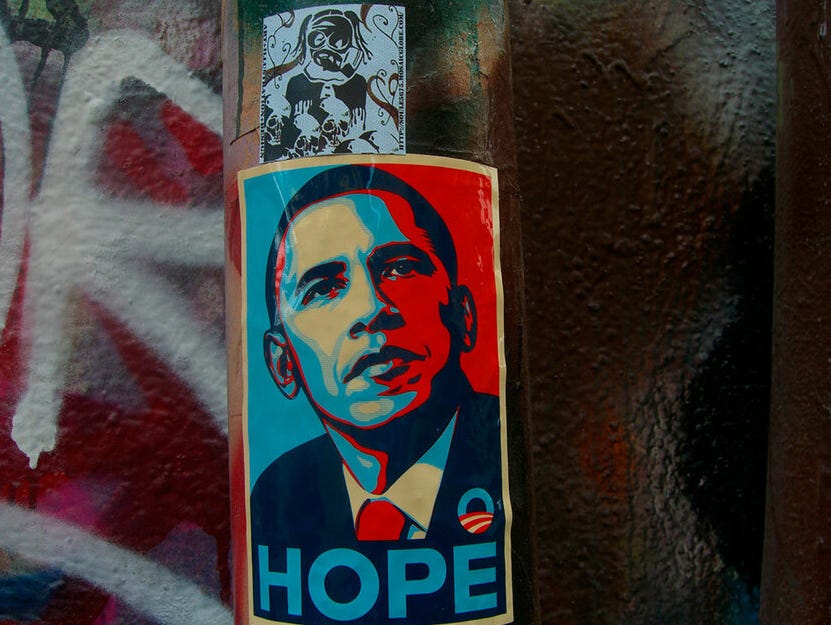
The Poster
Before Obama had a national record large enough to carry the hopes being placed on him, he already had the face: red, cream, blue, upward-looking, calm, serious without looking grim. In early 2008, Shepard Fairey, the Los Angeles street artist behind the `OBEY` campaign, sat down to make a political image unlike the ones that had made his name. Fairey had built his reputation on stickers, wheat-paste posters, propaganda pastiche, and a visual language that carried anti-establishment energy even when it was playful or commercial. His political art, he later said, was usually negative. But Barack Obama, then a first-term United States senator from Illinois running for president, struck him as a special candidate worth treating differently.
Working from an Associated Press photograph taken by Mannie Garcia in 2006, Fairey reduced Obama’s face to blocks of red, cream, and blue and placed a single word underneath it. The first word was `PROGRESS`. That was the version he first sent into the world, moving it the way a street artist would, not the way a campaign would. He made 700 prints at first, selling 350 on his website for $45 each and keeping 350 to paste up immediately.
Only after the image had begun to travel did `HOPE` take over. Fairey later said the change came after someone connected to the campaign worried that `progress` sounded too ideological and too easy for the right to smear as leftist. `Hope` sounded broader, softer, harder to pin down, and much easier to carry into a national campaign. Even at that early stage, the picture was being tuned for mass politics.
The money from that first run went straight back into the image, and the image kept moving. Fairey printed thousands more and sent them into primary and caucus states before the official campaign had fully made the picture its own. He and his allies pushed it the way people push something they think belongs to them: onto walls, onto bumpers, onto shirts, onto the web. A downloadable version went online so supporters could print their own. By late summer, bumpers, lamp posts, and building walls in major cities were carrying it. The picture stopped behaving like a designed object and started behaving like a grassroots contagion.
By late February, Obama had sent him a thank-you letter. By the Democratic convention in Denver, the poster no longer looked like an artwork circulating around a campaign. It looked inseparable from the campaign itself, even if the legal fight over the underlying Associated Press photograph came later.
A graphic language associated with subculture, dissent, and urban cool was suddenly helping to dignify a mainstream presidential campaign. Protest aesthetics were becoming campaign legitimacy. Before Obama had a settled national record, he had a face that could carry a whole public mood. The poster did not win the election by itself. It captured what many people wanted from the next phase of American life. In the middle of panic, exhaustion, and embarrassment, people did not only want a different program. They wanted a different expression.
The poster also contained one of the deeper tensions of the period from the start. It turned a candidate into a symbol on a timetable no presidency could satisfy. It made projection easy. Supporters and admirers could see more than a politician in front of them. They could see composure, intelligence, dignity, racial repair, and global fluency concentrated into one face. That concentration was powerful. It was also dangerous, because meaning was now outrunning record, and the administration had not even begun.
Grant Park
On the night of November 4, 2008, Obama walked onto a stage in Chicago’s Grant Park before a crowd that city officials estimated at 240,000 and declared, “change has come to America.” The sentence was simple, but the scene carried more than a campaign victory. The country had just chosen its first Black president in the middle of a financial panic, after two wars and after the long moral and political exhaustion of the Bush years. The crowd cheered, waved flags, shed tears, and even applauded John McCain’s concession speech. It knew it was witnessing a transfer of power. It also believed it was witnessing a repair of the national image.
By then the poster had done part of its work. It had taught people how to look at him. Then came the inauguration in January 2009, before a crowd often estimated at 1.8 million. The symbolism was almost too perfect. A young, eloquent, multiracial former law professor with a Kenyan father, a white Kansan mother, and a biography that stretched from Hawaii to Indonesia to Chicago seemed to embody not only electoral victory but national self-transcendence. He did not look like the old face of American power. He looked like the version of the country its admirers preferred to imagine.
The election had not arrived in a vacuum. It had arrived after breakdown. In October 2008, only a month before Election Day, the federal government had authorized the Troubled Asset Relief Program, the enormous rescue effort known as TARP, to stabilize the financial system after the crash. The policy may have prevented a deeper collapse. It also looked, to many ordinary people, like a country rescuing its largest institutions while households stared down layoffs, foreclosures, shrinking savings, and a suddenly humiliated idea of progress. By April 2010, Gallup found confidence in banks stuck at just 20 percent. Trust in the federal government was also down near a historic low. The damage was not only financial. It was moral. The order had survived, but its fairness, legitimacy, and trustworthiness had been badly shaken.
Obama offered something more immediate and, in some ways, more politically usable: a calmer public presence, symbolic elevation, a more respectable national image. Calm after panic, a less vulgar public style after the Bush years, cosmopolitanism after Iraq, moral seriousness after a crisis of fairness. To supporters, that looked like the country pulling itself upright. To skeptics, it could look like substitution: a better story, a better surface, a more persuasive face, without much evidence yet that the underlying bargain was being rebuilt.
People responded to that promise. The morning after the election, Gallup found that 67 percent of Americans believed a solution to relations between Black and white Americans would eventually be worked out, the highest reading Gallup had measured on that question. A year later, a Pew survey found optimism about Black progress had risen sharply among Black Americans despite the recession. Hope had acquired public form. Many people wanted to believe the country had turned a corner. Many others could see that the banks, the wars, and the bailout order were changing much less than the symbolism around them. They saw no reason those things should be treated as morally renewed just because the presidency had acquired a more graceful face. Expectations rose long before outcomes could be measured.
Why This Face Was Needed
Obama’s particular importance lay not only in what he represented, but in what sort of moment required representation like that. The country did not only need a president. It needed a reset figure. The wars had made America look reckless. The crash had made it look crooked and incompetent. Katrina had already shown bureaucratic failure in humiliating form. Now the bailout state was showing that federal power and elite finance could move quickly for the powerful while ordinary families were left to absorb the shock. A new tone was not enough to repair that rupture. A new tone could still make the rupture more bearable, giving people a way to feel that history was moving in the right direction while much of the old financial and geopolitical machinery remained in place.
His voice was measured. His syntax was orderly. He could sound morally elevated without sounding hysterical, and technocratic without sounding merely dull. He seemed comfortable with institutions while remaining mildly detached from them, as though he could inhabit the existing order without sounding entirely captured by it. For many educated voters and for many foreign observers, this was almost ideal. He looked like evidence that the country could learn, reflect, and become better. For critics, that same elegance could look like a way of making continuity easier to live with.
The fit between face and moment was unusually tight. A calmer decade might not have needed Obama in quite the same way. A harsher, more openly shattered decade might not have been satisfied with him. The late-2000s and early-2010s wanted exactly this kind of public symbol: elegant, reassuring, modern, post-racial in tone, managerial in bearing, global in reach. He let the country imagine itself as intelligent, historically teachable, and capable of self-correction before the banking order, the war footing, or the bailout politics underneath had been remade.
Global Prestige
On the morning of October 9, 2009, Obama learned that he had won the Nobel Peace Prize. The timing was bizarre enough to sound almost satirical. The nomination window for that year’s prize had closed on February 1, less than two weeks after he took office.
Obama himself seemed uncomfortable with the timing. In the White House Rose Garden that morning, he said he did not view the award as recognition of his own accomplishments. In Oslo two months later, he admitted that he was at the beginning, not the end, of his labors on the world stage, and then accepted a peace prize as the commander in chief of a country fighting two wars.
The award reflected how quickly Obama’s symbolic value had gone global. It recognized atmosphere, direction, and the belief that America, by changing the face of its presidency, had changed its meaning. He functioned as a cosmopolitan repair figure: proof that America could appear less coarse, less unilateral, less provincial, less intoxicated with its own force. He brought relief simply by changing the emotional temperature of the office.
Abroad, the response had been immediate. A July 2009 Pew survey found that the image of the United States had improved markedly in much of the world, driven in large part by confidence in Obama. In Germany, favorable views of the United States jumped from 31 percent in 2008 to 64 percent in 2009. Similar rebounds appeared across Western Europe and in parts of Latin America, Africa, and Asia. Allies and admirers were reacting not only to a new administration, but to a new American self-presentation: calmer, younger, more cosmopolitan, easier to respect.
The Nobel did not create that prestige. It revealed how far it had already traveled. On June 4, 2009, at Cairo University, he had delivered `A New Beginning`, promising a reset in relations between the United States and Muslims around the world, speaking in the language of mutual interest and mutual respect. The prize followed that new tone more than it followed any completed diplomatic settlement.
The prestige had limits too. The same 2009 global survey found strong improvement in many countries, yet much less improvement in parts of the Muslim Middle East. Admiration and skepticism coexisted. So did soft power and hard power. That Cairo address promised a new atmosphere; meanwhile the United States kept up its controversial campaign of drone strikes against suspected militants in places like Pakistan and Yemen. The Nobel recognized aspiration; the wars and counterterror state did not simply disappear. The country could look morally restored while its hard power remained morally tangled.
The Cool President
Part of Obama’s strength was that he was not only presidential in the old sense. He was media-native in a newer one. He seemed to understand that in the twenty-first century a leader did not merely govern through speeches, laws, and press conferences. He also had to work through clips, comedy, interviews, and other media forms that traveled on their own.
Even his attachment to the small machine in his pocket fit the image. Before taking office, Obama fought to keep his BlackBerry, a smartphone made by the Canadian company Research In Motion, because it had become his constant campaign companion. Security officials worried about protecting presidential communications, and White House lawyers worried about what records law might require of every message. A compromise finally let him keep a heavily restricted version so he could stay in touch with senior staff and a small circle of personal friends. His press secretary, Robert Gibbs, said Obama believed the device helped him escape the presidential bubble.
The larger culture reinforced the same image. Oprah Winfrey’s endorsement had already given him a kind of celebrity legitimacy before he reached the White House. Later came the full Hollywood embrace, including George Clooney’s star-studded 2012 fundraiser, which brought in a record $15 million in one night. The entertainment world liked Obama not only because he was a Democrat. It liked the role he seemed born to play in public life: tasteful, articulate, self-possessed, historically meaningful, and easy to admire without embarrassment.
Much of the national press responded to the same qualities. One study of Obama’s first 100 days found substantially more positive coverage than in the early months of either Bill Clinton or George W. Bush, and found the coverage unusually focused on leadership ability, management style, and political skill rather than on policy alone. Criticism did not disappear, but a good deal of early coverage approached policy through the drama of temperament. The press was often judging not just what Obama did, but what kind of person he seemed to be while doing it.
In his first months, Obama signed the Lilly Ledbetter Fair Pay Act, an equal-pay law, reauthorized the Children’s Health Insurance Program, pushed through the Recovery Act, and moved to stabilize the auto industry in the middle of the economic emergency. Large decisions were being made. Even then, the story of those decisions often ran through style, symbolism, and managerial poise. The presidency felt unusually personal even when the machinery of the state was doing large and consequential things.
At the 2011 White House Correspondents’ Dinner, Washington’s annual press-and-celebrity ritual, only days after the White House had released his long-form birth certificate to try to bury the birther conspiracy, Obama turned the whole episode into material. He joked about the birth certificate, mocked Donald Trump, then a New York real-estate celebrity and the loudest birther in the country, to his face, and handled the room with the ease of a practiced headliner. By then the job was asking for competence, yes, but also fluency in irony, celebrity, and spectacle. He was supposed to look above the noise while proving he knew exactly how the noise worked.
The fluency kept appearing. In 2012 he went on `Late Night with Jimmy Fallon`, the NBC late-night host, to “slow jam the news” about student loans. In 2014 he sat down with Zach Galifianakis, the comic actor and creator of `Between Two Ferns`, using absurdist web comedy to push HealthCare.gov toward younger audiences. The White House blog promoted the clip like an ordinary viral item, joking that all your friends had probably seen it, so do not be “that guy.” Obama could use the new media environment without looking diminished by it.
The effect was not only power but currency. He looked at ease in the screen age, on the devices through which people were organizing more and more of daily life. He could move between the Situation Room, Cairo University, the Correspondents’ Dinner, late-night television, and internet comedy without seeming to switch species. That versatility was part of the charisma.
Symbol and Limit
Obama became more than a political leader. In him, many people could see racial progress, generational change, elite competence, global respectability, and a restored sense of adult seriousness fused into one public image.
Yet the limits of the face were built into its success. A face can restore poise even when a political and economic order remains unjust. It can calm a mood while the charges against that order remain unsettled. The symbolic ascent was unmistakable. So was the deeper instability underneath it. The banks survived. The foreclosures kept coming. The country sounded wiser. Trust remained damaged. The world liked America better. America had not escaped itself.
Even the maker of the poster eventually felt the gap. By 2015, Fairey was saying Obama had lived up to the word under the portrait “not even close,” citing drones and domestic surveillance among the disappointments. The image had promised more than any presidency could safely deliver, partly because the moment demanded more than policy detail. It demanded reassurance, elevation, and a story of repair.
A crisis of fairness had been answered, in part, with a story of moral progress. For a few years, recovery looked more decent, stabilization more moral, and the country more admirable to itself and to much of the world. The arguments underneath it, about fairness, war, finance, and trust, had not gone away.